The Silencing Effect of ‘Good News’…

Evangelicals are, by definition, supposed to be bearers of ‘Good News’.

When I was little (prior to New Guinea, so I’d have been maybe 5 or 6), there were some neighbor boys in E. St. Louis who would come and terrorize me and my brother.  Dad had built us a ‘fort’ on on the back of our property in the woods, and these boys would often just show up.  They were older than either me or Bill at the time: I believe Tiger was 16 and Jeff was 11.  We complained to dad about their presence and said they were ‘mean’ to us, but he reminded us they came from a ‘broken home’ and that we should try to include them.  Well… that shut the two of us up from ever feeling free to complain about them.  They stashed porn in the fort, and my brother and I would burn it or hide it because we were afraid.  And once, while I was alone with them, they exposed themselves to me.  (My brother was in school and I wasn’t, so I must have been pretty small).  I came into the house crying, and dad asked what was wrong.  I told him they were being ‘mean’ again, and he said, “well… remember… they aren’t from a Christian home… so try to be nice and ‘turn the other cheek’.”  We stopped playing in the fort altogether.  And nothing more was ever said about it.

When I was 19 I took a job across the state and worked for an inner city mission, holding summer camps for youth.  There was a man who volunteered who was 32.  As young girls are wont to do, I found him attractive, and I’m sure I acted like a 19 year old in my behavior to him.  One evening, late in the summer, he asked me to go for a walk with him.  We hiked up a trail in the woods–and there he became quite ‘handsie’ with me.  I was uncomfortable. No guy had ever acted that way with me before.  Danny complained “haven’t you ever had a boyfriend before?” I said nothing as I was too ashamed to admit that I was inexperienced in these matters.  I can’t imagine how it could have been fun for him, as I know it had to have been like kissing a brick wall.  But I endured and said nothing.

That weekend, dad and mom came to visit.  While alone with dad, I pointed Danny out and said “He’s not been very nice to me.”  Dad shrugged and said “well… you know how to handle yourself.”  So I was silent, feeling judged for not having been more resistant… for letting things go as far as they had… etc.

I spent the next month pretty much terrorized by Danny who would show up at my cabin late at night and want to fool around.  Suddenly I felt like there was no ground to say ‘no’.  There was no support. I’d already let things go shamelessly too far with him, and I was to blame because I’d not stopped it the first night.  After about a month of this, I quit the job, packed up and returned home, only to have my dad and mom talk to me about making commitments and not quiting.  “People at the mission were counting on you, Donna.  Those  kids were counting on you.”

And I’ve never talked to my folks about that either.

I went back to my small conservative Christian college my for my junior year after this experience with Danny feeling pretty miserable.  While I was too ashamed to tell my parents about it, I was even more afraid of how the college administration might react: I knew plenty of gals who got kicked out of school because of similar things.  I felt like I’d done something really wrong, but couldn’t tell a soul–couldn’t confess my ‘sins’.  (The bizarre thing was–I’d really not done much of anything–just didn’t resist his advances–yet I carried around an amazing amount of guilt.)

I bear a weight of ‘guilt’ these days, not for having had the experiences I’ve had, but rather for not being more honest with my parents.  And yet I also do not think it is worth the bother at this point in our lives or in my relationship with them.  I don’t feel known at all by my family–these things which were so big, and so formative to me will remain unspoken.  And at the same time, I don’t see any ‘good’ coming from sharing it with them–it would only foster an-already-too-late sense of guilt in them.  And they don’t need that, and neither do I.

The events with Danny were very formative to my relationship with Mark (who I was eventually engaged to). Once things progressed as they did with Danny, there seemed no reason for them to not do so with Mark (I know that makes no logical sense, but somehow it worked that way).  Enduring Danny left me stupidly willing to endure a lot of other things from men.  At any rate, even though I knew things were terribly wrong in my relationship to Mark, I couldn’t talk to anyone about it, and I found myself in that crazy cycle of guilt again.

When Mark and I broke up, I walked away having come to the conclusion that if everything is sin, nothing is sin.

It was this experience, coupled with the unintended silencing of the holiness tradition, that made me really begin questioning the whole ‘Wesleyan’ agenda.  I felt a real and certain need for this to be known, and couldn’t risk talking about it with anyone.  Five years passed before I ever told anyone.  That was the head-space I was in when I entered Seminary: I had learned the ‘Good News’ functioned to silenced the bad, but never quite ‘eradicate’ it.

Imagining the worst…

When you grow up in the so-called ‘third world’ you never ask Rabbi Harold S. Kushner’s famous question of “why bad things happen to good people.” Catastrophe and disaster are known entities, and when posed with this sort of question, the only reasonable response is “and why wouldn’t they?”  Kushner’s is a question borne out of privilege and luxury–where safety is an assumption: societal structures are in place to stave off most predictable disasters and most crimes are located on some ‘other’ side of the tracks.

When you grow up among the poor, you realize that safety nets are illusionary and death is a possibility.

The first few years in Papua New Guinea, we lived in the capital city of Port Moresby.  It was the most modern (and therefore western) city in the country, and I remember when the first stop lights were installed, and the first escalator was built-in an office building.  It was both amazing and amusing to watch a grown man barefoot and in traditional dress (tanget leaves and a bark belt) step onto the escalator and then jump back in surprise when it began to move.  It took him hours to brave his first ride.

Port Moresby was a clash of cultures and climates.  Situated in a coastal basin, it was surrounded by mountain ranges. The heart of the city was almost desert-like, whereas the mountains were lush rainforest. There were no external highways that led over these mountain ranges, so the city remained virtually isolated except by air and sea. There were many highlanders who had heard of jobs and educational opportunities in the capital, and had pulled together enough cash to buy a one-way plane ticket to the city. They left their villages with the promise of earnings and all too frequently found themselves jobless, homeless, and stranded without wantoks (one-talks: people who speak the same language and are therefore from the same village) to help them get started. As such, a growing mass of squatters accumulated in the capital.  And with squatters, crime. Juxtaposed with the extreme poverty of these transients, were the luxury homes of plantation owners and diplomats which dotted the hilltops. As such, white-skinned people were targeted: the assumption of wealth based on skin tone was clear.  We all had security fences, guard dogs, house boys, etc. to maintain our own tenuous facade of safety. But even with those measures intact, crime was something we lived with: I remember buying our own radio back on the black market: our name painted clearly on the top of it for all to see.

One week during fourth grade at the international primary school I attended, Lorraine, one of my classmates, went missing from class.  No one said a word to us students about it, but her desk was packed up and belongings were sent home. I went home and asked my mother about her.  Mom didn’t know, but we pulled out the weekly paper to see if any news would enlighten us.  There it was: Lorraine and her mother had been gang-raped and were immediately removed and sent back to their home country.  Her father was tying up loose ends and would be meeting them there soon.  I remember the look on my mother’s face when she read this aloud to me.  I didn’t know what ‘rape’ meant at the time, but I figured it must be just about the worse thing that could ever happen to you–worse than even death.

That night, I laid in bed and fantasized about what the ‘worst’ might be.  My ten year old mind could not wrap itself around a concept of sexual assault: at the time that was a distant and meaningless reality.  So what could be the worst thing ever that could happen to you? I remember comming to the conclusion that it must mean that someone cuts off your arms and legs (I’d seen folks from the leprosy colony nearby: I knew you could live with one of these missing, but I couldn’t imagine how you’d live with all four gone!).  From that night on, whenever I’d get scared (such as at fortnight when guys got their paychecks and had been out drinking and carousing), I would lay in bed in a ball, facedown on my arms and legs, trying to protect them from being ‘raped’.

While I’d gotten the specifics wrong, it never occurred to me that such a thing couldn’t happen to one of my family members: we all knew someone who’d been touched by violent crime or some other type of catastrophe.  In my head, it was a matter of time: odds were, something awful was going to happen sooner or later–it was an issue of numbers.

And so we lived in expectation of the worst: danger lurked everywhere, but it didn’t keep us isloated nor was it paralyzing: the work of the church was far more important than any ‘thing’ that could happen to us.  And if something bad did happen, it would be “all to the glory of God” (thus enforcing the cycle of the work of the church).  How much money could be raised if something truly bad happened!  It was fascinating to imagine: I could be the armless, legless little girl who brought salvation to New Guinea. Money from the U.S. would pour in!  As would my guilt, subsequently, for fear that if I imagined it–it might actually come true: and I didn’t want to be an armless, legless little girl! I didn’t have the courage to be ‘raped’.

It was this sort of magical thinking that led me in college to, upon spying an utterly disgusting and unsuitable male, declare him my ‘future husband’ to anyone within earshot.  To do so would ‘trick’ God into thinking I wanted it to happen–and I knew that nothing I wanted–my happiness–was the ultimate preventative: God would never give me the desires of my heart (because I failed to focus and ‘delight’ on Him).  Better to pretend to want what repulses me on the off chance that it might produce an opposing effect; God would instead  find someone truly wonderful for me to marry.  God ‘worked’ that way (His mysterious ways).

Orders of salvation…

This piece was written a while ago, but is one of the incidents which prompted me to study theology after nursing school. I couldn’t move beyond the fact that salvation seemed to come in various forms.

Jenny put her call light on and motioned me to her bedside.  I questioned to see if she was having any pain.  She indicated that she just wanted company; the hospital after visiting hours can be awfully lonely, especially on the oncology unit.  Knowing she was single and had no family close to share her burden, I sat down and asked her about the middle-aged woman she had been laughing so heartily with earlier that day.  She relayed the following story to me regarding her double mastectomy two years before:

“I couldn’t stand to look at myself,” she commented.  “The hollowness to my profile…reduced to the appearance of a schoolboy.  The scars that move in all directions from my armpits to my sternum—the keloid ridges and lack of sensation.  There is nothing feminine about this.  There is nothing sexy about this.  I didn’t want to be touched.  I didn’t even want to leave the house.

“I don’t know why she insisted upon seeing it.  But after refusing to meet for weeks—mostly because I didn’t want to be seen in public—Linda called and announced she was coming despite my protests.  She surveyed the messy house with a hint of surprise in her eyes but didn’t comment or pass judgment.

“She merely took me by the hand and led me back to my bedroom.  ‘Let’s see it!’ she demanded.  My protests fell on deaf ears.  I stood there feeling humiliated and angry.  Why was my best friend placing me on display like some freak circus act?  Tears of frustration and misunderstanding slid down my cheeks.  She was unrelenting.

“Finally I acquiesced.  She stared me straight in the eye, holding my gaze as I unbuttoned my blouse and slid my camisole strap off my shoulder.  I saw her eyes descend from my face and I stared stoically over her shoulder.  A hand reached out and traced the edges of my scars…but I couldn’t feel it.  She bent forward and I glanced down uneasily.  Very tenderly she kissed the mangled tissue.

“Our eyes met and she stood upright and held me close.  Together we cried—grieving the loss and the indignity—but mostly grieving the space that had developed between the two of us.  Her restorative touch and sensual acceptance reinstated my personhood.  She is my best friend.  She saved me.”

Life uncustomized…

Upon leaving New Guinea for furlough, it became clear that neither of us kids were ready for re-entry into the full-swing, 80’s, North American, upwardly mobile, yuppy experience. The materialism we encountered was striking: we knew nothing of Gloria Vanderbilt jeans, Guess watches, Izod shirts, or Polo cologne.  In fact, neither of us were certain of our shoe or clothing size.  In general, we’d spent the previous years sorting through what was available for what might fit, not for what we preferred–whether in used clothing boxes or at the local merchant in the city.  On our way back to the U.S. on furlough, we had a layover in Brisbane, Australia, and spent some time getting acclimated to western stores, crossing streets, ordering food, etc.  I recall walking in a department store and going up to a clerk and saying “I think I wear a size 10.”  She just stood there looking at me dumbly.  I repeated myself.  She then asked what it was I would like to see.  “Whatever you have in my size, please.”  She laughed and said, “But honey, we have everything in your size.”  I was overwhelmed.

I remember one of the few times we had to special order a customized item (at least as a kid, this is how I thought of it).  We’d each had complete physicals prior to leaving the United States, and had received the requisite vaccinations and medications for our protection against tropical communicable diseases.  The shots were not fun, but as it turned out, the anti-malarial medicine was much worse.  Chloroquine tablets had to be consumed weekly in order for a beneficial level to build up in the bloodstream.  One might not imagine that swallowing a small pill each Sunday was a big deal, but it was incredibly bitter and rarely could one of us get it down without gagging uncontrollably. Worse yet was the fact that this bitterness took days to leave; everything consumed for the following half week was tainted with the odor and taste of chloroquine. To add insult to injury, the chloroquine didn’t prevent us from getting malaria.  It only supposedly made our frequent bouts with the disease less life-threatening.

Along with the nasty taste were some extraordinary side effects: scar tissue turned a deep purple color (making any disfigurations all the more noticable), and our vision gradually became impaired.  Within six months of our physicals and beginning the chloroquine, we went from having 20/20 vision to needed glasses.  Like most kids who aren’t aware they need glasses, I didn’t know what was happening to me.  All I knew is that whereas I’d been in the ‘gifted’ classes in the United States, suddenly I was stupid.  I sat in my fourth grade class unable to read the chalk board (actually, unable to even tell there was writing on the chalk board).  I covered for my visual impairment poorly, without consciously being aware that I was doing it, until one day the teacher asked me to read something she’d written on the board.  I sat there dumb.  She thought I was being impertinent and demanded I read it.  I told her I couldn’t.  In what seemed to be a typical British form of pedagogy, she began openly mocking me in the classroom.  When I told her I couldn’t even see what was on the board, she whipped my desk up to the front of the room, and had me sit there with my desk flush up against the blackboard, asking me to read at her convenience.  I was humiliated!

Mom and dad took both of us kids to the eye doctor and were immediately surprised to find out that we’d both had severe visual changes over the last 6 months.  It became clear that not only did we need glasses, mom and dad’s prescriptions had also changed.  And while we were able to secure a prescription for glasses there in the capital city, there was no optometrist shop to actually procure the lenses and frames.  With such a large sudden expense (all four of us requiring glasses immediately), it was clear we couldn’t all fly to Brisbane to see the eye doctor.  It was determined that dad would go and choose glasses for each of us (including mom).  My poor father recalls a very stressful afternoon with an Australian store clerk as she tried on various frames and he tried to imagine what each of us might look like in them. I ended up as a 10 year old with an adult-size set of frames. Needless to say, the results were less than desirable.

Me playing the guitar at 10 years old... with my giant glasses.

Me playing the guitar at 10 years old… with my giant glasses.

On modesty observed…

My first day of high school in the United States while we were on furlough was to a very large suburban high school (of approximately 4000 students). I was fresh in the country from the ‘bush’ and was, to say the very least, nervous. My brother and I were ushered to the guidance counselor’s office, who reviewed our transcripts and poured over scheduling possibilities. Once classes were finally selected, we were given maps of the school and set off into the hallway. It happened that my first class was P.E. (physical education).

The maps we were given were confusing, and my brother was anxious to be rid of his little sister.  He fled down one hall as quickly as he could lest I embarrass him with a strange question asked (or worse, a question strangely asked).  He was no help. I stood there and looked at my schedule and saw that the time was right and my first class was to be held in the Gym-SW.  I stared at the map, noting there were 3 gyms in the building. I searched for the gym on the southwest corner.  No such place existed. I opted to go with the gym that fit that description in closest proximity.  Alas! it was not the gym. A kind teacher pointed me in the right direction.

I wondered around somewhat lost still, until I located the gym I was supposed to be in: turns out SW stood for ‘swimming’ and my schedule had me at the pool first thing.  I was confused because the map depicted a two-story building (something I wasn’t accustomed to accounting for)–and was thus VERY late.

Upon arrival at the pool, I reported in to the teacher who stepped back, sized me up, and threw a swimsuit in my direction. “Go get changed,” she briskly told me. “The other kids are already at the pool.  Meet us there.” I wondered into the cold grey cavernous locker room, found an empty locker, and began to undress.  The swim suit she’d given me seemed the right size, but I was feeling cautious.  I stood and looked at myself in the full length mirror.  I was aghast. The suit was quite immodest-far more than anything I’d ever been allowed to wear in the past (more so than anything I’d choose to wear).

I took a deep breath, steeled myself, squared my shoulders and reminded myself that everyone else would be wearing the exact same uniform.  There was no need for me to feel embarrassed because everyone would be dressed this way.  I talked myself into going out to the pool, and to do so with my head held high.

I walked out of the locker room and to the pool in utter silence.  Everyone was sitting on the bleachers at poolside, apparently waiting to be introduced to the new kid, the foreigner, the missionary kid. I was familiar with this sort of attention. I quietly took my seat next to a young woman I recognized from church.  She glanced at me sideways and said, “Nice tan lines.”  I smiled.

The teacher read the rules of the pool to the class, then invited everyone to get in.  “Everyone except Donna, that is.  Donna, would you please come here?” She whispered in my ear, “You have your swimsuit on backwards. Go fix it and come back to the pool.”

Welcome to high school in the United States!

Life in the stone age…

Occasionally anthropologists and archeologists would show up at the boarding school and ask for one of us kids to translate for them when they went to a village or site.  I went along one day with two such scientists and a local guide to explore a cave the scientists had heard about.  This cave supposedly had a hidden entrance and ran from one side of the mountain to the other. It wasn’t that the cave was a secret to any of the local tribes: rather it was the river that ran through the cave that often made it inaccessible and dangerous.  New Guinea is famous for its bi-seasonal weather: the wet season and the wetter season and flash flooding was a real possibility.

The local man walked us on a well worn path, barely wide enough for one person to pass.  We walked several hours into the bush and up a gentle slope towards the mountain.  Our guide stopped short suddenly and parted some foliage exposing the entrance to the cave. We stood at the entrance, per the guide’s instructions, and listened carefully. We could hear the sound of water running deep in the mountain.  We secured our torches (flashlights), wrapped in plastic bags, slipped long sleeved shirts on over our bare skin (to protect our hides and prevent leeches from getting on us), and entered the cave.

The water was ice cold and at its deepest we were wading with it around our waists. The cave, it tuns out, ran the length of the diameter of the mountain–several miles deep with little change in elevation from the initial decent into the cave opening.  It didn’t take long before walking became difficult as our legs were numb from the cold. We’d pause on the occasional boulder and sit above the water level, trying to warm ourselves. During these pauses we played with sound (listening to echos) and darkness (there is NOTHING as dark as when you turn your flashlights off while spelunking).

At one point, approximately half way through the cave, the guide stopped us and had us climb up onto a large ledge. The cave opened up into a large room, and the guide pointed up to the ceiling and had us shine our lights onto the rock walls.

The scientists inhaled sharply. The walls were covered in cave man drawings.  They immediately jumped up, reenergized, and began shooting photos, filling the cave with blinding flashes of light.  Our guide was startled and frightened by the sudden onset of inexplicable lightening.  I quickly explained the camera and flash and asked one of the scientists to ‘flash’ us on cue.  Soon we were all laughing.

I listened while the anthropologist and the archeologists explained the nature of the drawings, including what various symbols meant.  It was then I remembered our guide was local–perhaps he knew some of the folklore behind this ancient artwork.

The guide seemed puzzled at my question, then described a lengthy ongoing battle between two local tribes.  “We carried our pigs and children here. The women came too so the men could fight without worrying about them. These drawing were done while the women waited.”  How long ago was this, I asked?  “Oh… I think two or three Christmases ago.”

These ‘cave men’ were outside in the village, planting gardens, telling stories, and laughing. They were not ancient tribes. They were contemporaries.  I explained this to the scientists, who sat in silence. There was no good way of explaining their initial interpretation to the guide. There was no way of explaining to him, as he shone his flashlight in our faces, that he was from the stone age.

One among many…

Boarding school was presented to us missionary kids as the pinnacle of achievement: that is, you knew you were finally grown up when you were ‘allowed’ to attend with the big kids.  I’b been attending an international primary school for 4th and 5th grades and had been largely bored and lonely.  My grades were good, and my folks offered to let me choose to skip the 6th grade and advance to 7th–and therefore to boarding school.  I was 11.  I visited the school, met with the instructors and passed their oral examinations and was welcomed to Ukarumpa High School.

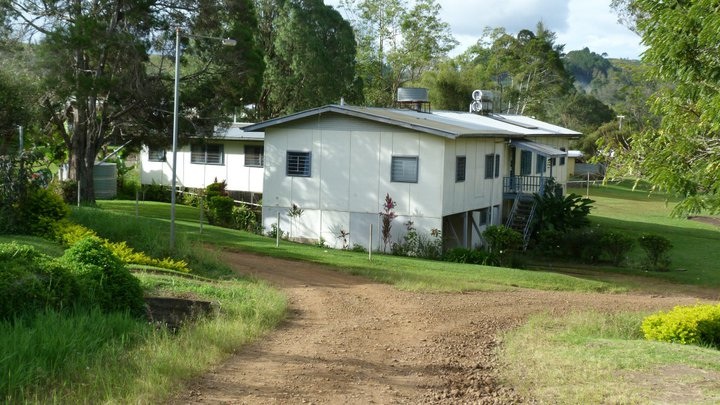
Ukarumpa, the international boarding school, was situated in the highlands of New Guinea at the Summer Institute of Linguistics (SIL) near Aiyura (where the airstrip was), about 13 kilometers from Kainantu.  I moved into our denominational hostel (one of several hostels on campus which were denominationally funded) and became the youngest child in a house of 12 kids ranging from age 11 (me) to 19.

The denominational hostel I lived in starting in 7th grade.

The Naz Hostel.

The twelve of us were ‘parented’ by whichever couple in our mission drew the proverbial ‘short straw’.  These people weren’t called to the mission field to take care of each other’s kids.  They’d sold their belongings and moved half way around the world for the singular purpose of spreading the Good News of Jesus Christ.  That the missionary kids required education and tending to was at best an afterthought.  The couple stationed at the hostel were only assigned for a short period of time (usually upon arriving back from a year’s deputation in the US, while they were waiting for their position at the Bible College or the hospital to be vacated). We kids were a bump in the missional highway–an assignment most missionaries tried to avoid.

As such, the turnover of house parents was rapid and frequent. We would go through periods of time where we had a different set of ‘parents’ every six weeks.  Often the people the mission hired to take care of us were barely older than we were (one couple was only 5 or 6 years older than the oldest ‘kid’).  It was a chaotic and disruptive existence, never knowing what expectations were, what meals would be like, what might be considered funny and what might very well offend.  Some people had their own children to tend to, and found the disruption of the other missionaries’ kids in the household to be nuisance.  Others felt a need to save the mission money and doled out food and supplies as if there was significant scarcity. Some were not any more mature than we kids were.  Many felt free to criticize the parenting style of our biological parents—the missionaries they took exception to: often humiliating their kids who were at their mercy for 10 ½ months of the year.  Some couldn’t cook; others couldn’t even speak the local language and go to the market by themselves. Most had little to no theological training and functioned on a folk theology where sacrifice was uplifted as their highest calling, souls were at stake, and we were frequently told that to create problems (that is, to not behave and do what we were told, or to complain too much) would force our parents away from the work that God had called them to—the consequences were dire as souls might be potentially ‘lost’.  If our parents were tending to us, they weren’t doing God’s will.

During my tenure at Ukarumpa, there was one set of house parents who stayed for a full year without disruption.  They were an older couple, fresh back from furlough.  Their own kids were grown and they had enough distance from them to provide some stability in our lives. They laughed a lot, spent time alone together, and cooked together.  They were not perfect: his tolerance for childish nonsense was slim, and he spent a lot of time talking about “Blessed Quietness”—an old holiness song—especially when we got too rowdy or raucous.  He paddled the boys occasionally when they were bad, and looked upon misbehaving girls with contempt.   If we were late getting up in the morning, he’d walk down our hall with a pan from the kitchen and a metal spoon and bang until we got up.  When the hostel’s dog, Beast, got old, he waited till we kids were out of the house, then shot the dog and buried him.  When we cried, he told us it was ‘just a dog’.

She was lovely—tall, stately, elegant.  She played the piano and the violin and had an infectious laugh which was accompanied by an impossible twinkle in her eye.  Everyone loved her with a reverence which created space—quite literally.  She held herself at an emotional arms-length from us, treating each of us with professional competence and the care only a nurse could offer.  But she hardly mothered us.  She had favorites, and I was not one of them.

They had their own living space apart from the dormitory we kids lived in.  It was taboo and we kids were forbidden to enter.  They would disappear behind closed doors each evening, not to emerge again until morning.  Each night when I went to bed, I wrote in a notebook: a diary of sorts describing to her my day and thoughts, sometimes just the love letters of a little girl in need of a mother close by.  I would slide the notebook under her door and go to bed.  In the mornings, I’d find it on my desk—in pristine condition, without evidence that it had been read or even opened.  Nevertheless I’d write.  I think it was my way of having a little time with her alone (an impossibility with 12 kids, but also given her ‘distancing’ personality).

Years later, when I moved to Kansas City to attend Seminary, I was delighted to find out that these house parents had retired nearby.  My own parents had moved to Vietnam, and I found myself ‘orphaned’ once again in a strange country.  I imagined contacting these newly retired house parents, and having a place to ‘go’ occasionally and a ‘family’ to fall back on if I needed support.

It was a harsh reminder of childhood days the first time I went to visit this retired couple.  Whereas I considered them “mom and dad” for a year of my life and a real source of stability, they saw me as a painful reminder of a year of lost ministry—a year doing a job they never wanted and didn’t feel called to—I was one among 12 kids who never really were theirs.   The emotional arm’s length had stretched miles.  It shook me to my core.

And I began to feel more at ease being the orphan, than the less-than-desirable foster kid.

Why do whites have so much cargo?

The opening narrative of “Guns, Germs, and Steel: The Fates of Human Societies” by Jared Diamond depicts a man named Yali from New Guinea asking the question, “Why is that you white people developed much cargo and brought it to New Guinea, but we black people had little cargo of our own?”  I was 34 when I first read this book, and the question Yali posed made me smile.

When we moved to Papua New Guinea from the United States, we were afforded by the mission a certain sized crate to ship belongings over.  We were warned that at best, the shipment would arrive 3 months after our arrival by plane, thus we were encouraged to bring as much as the airlines would allow with us on the journey, knowing it needed to last us that whole time. My folks had two small children in tow: so our suitcases contained not only clothes and towels and toiletries, but toys as well. At that time, the airlines would allow one carry on bag, and two checked bags free of charge.

Our flight left St. Louis, with a layover in Los Angeles, and another in Honolulu.  My parents scheduled us a few days in Hawaii as a means of adjusting to the time change, climate and temperature change, etc.  When we arrived in Honolulu, and attempted to hail a cab to take us to our hotel, we realized this could be quite a production.  We’d need a van or a large station wagon to carry us as we had so much ‘cargo’ along for the trip.

When my father finally flagged down a large station wagon cab, we crowded to the curb with all our luggage.  The driver opened the back of the wagon, then rounded the car to the curb we were waiting on.  He eyeballed our bags-all twelve of them-with obvious amusement and skepticism.  “Just how long are you visiting Hawaii?” he asked.  Mom’s response was quick “Three days.”  He stood there gapping, then shaking his head laughing, loaded the car.  When we arrived at the hotel, mom quietly asked dad why the cabby acted so strangely.  Dad explained, “He thought we each had 3 suitcases for our visit to Hawaii.  That’s one suitcase a day for each of us.”

Little did we know that this interpretation of our baggage would serve as a metaphor for our whole tenure in New Guinea.

When anesthesia isn’t an option…

My eleventh birthday, April 7, 1982, was a remarkable day. I’d gone to school that morning as usual, in my blue and white uniform and patent leather shoes.  On and off during the day, I’d experienced pain.  I mentioned it to my teacher, who in the best of the British educational tradition, told me to “steel yourself and carry on.”  By 2 pm I was miserable.  My family lived about a mile away, and the pain became such that I finally just walked out of class and out the front gates under the threat of a caning by the head mistress–I walked home.

Mom said I was blue/green around the mouth by the time I climbed the steps of the front veranda. I could barely stand upright. Mom and dad immediately bundled me up and drove me down the road to the general hospital in Port Moresby. Upon arrival it became clear that my appendix was hot–if not ruptured already, then just about to.  They handed my mom a razor and a bottle of Phisohex and told her to prep me for surgery.  Dad ran out to the car and got the blanket they’d earlier bundled me in.  He held me up in the shower while mom prepped me.  They dried me off in the blanket from the car.

Dad carried me to the gurney, and laid me down.  The doctor indicated one of them should accompany me to the operating theater.  They carefully instructed my dad to take his shoes off prior to entering the ‘sterile’ environment.

For reasons my family never quite understood, the doctors gave me a very mild sedative but no anesthesia.  They strapped me down to the bed and removed my appendix under the sedative effects of Benadryl. When I rose up in pain onto my elbows, they instructed dad to hold me down.  He leaned over me with his full weight, and talked me through the surgery by describing the equipment in the room until I finally passed out.

I came to in a general surgical ward which consisted of eights beds, four on each side in rows on a concrete pad, surrounded by mosquito netting.  There was a sink at the end of the aisle between the 2 rows of beds.  Mom laid on a bamboo matt under my bed, waiting for me to wake and ensuring my safety. I was in severe pain, and mom wasn’t able to convince anyone to give me any pain medicine–they had left my belly open with a drain intact, out of fear of infection.

Mom stood by the bedside and we watched rats climb the mosquito netting. After a few hours, the doctor came to the bedside and suggested that my folks take me home, as “it is likely cleaner at your house, than it is here”. Dad bundled me up in the same blanket we’d earlier used as a towel, and trying to be as gentle as possible, laid me in the back of the car. We drove the long bumpy ride home slowly and painfully.

I believe my parents were more traumatized by all this than I.

Tu kina meris and haus lotu

Expatriates don’t buy land in Papua New Guinea.  Instead you can make application to the government for a 99 year renewable land lease.  You can request specific locations, but it is up to the government’s current agenda for development as to where they parcel out a lot.  Such was the case when our denomination applied for land in the capital city.

The land grant the government designated for our mission was located in an underdeveloped part of the city which consisted of several acres of tall kunai grass (6-8 ft tall and razor sharp) and a grove of rain trees.  This area was crime ridden–the grass hid a prostitution ring. Each fortnight there was excessive drinking and gambling under the rain trees while men lined up, freshly minted paychecks in hand, and waited for their turns with the tu kina meris (or in English, two dollar women).

The denomination received a grant for three acres and promptly built a fence around its parameters to protect the property. This security fence was 8 foot tall and had 3 additional feet of barbed wire strung along the top angled outwards to keep the undesirables out.  As it turned out, the property line shifted the prostitution ring out from under one set of rain trees and pushed them over to another row just outside the fence the church erected.

The displacement resulted in an underlying hostility between the pimp, the prostitutes, the ‘customers’, and the mission.

The first thing the mission did after erecting the fence, was to construct a house on the property.  The domicile then served to house the mission workers while the church building was under construction.  My family lived there.

Because of the underlying animosity against the mission for displacing them out from under the comfort of the rain trees, the prostitution ring began practicing right outside our front gate under a few trees just outside the fence.  Drunken brawls were not unusual, and on occasion, my father had to phone the police to ensure our protection: drunken threats were made towards those within the safety of the fence; beer bottles hurled against the house; etc.  We hired a security man to live onsite, and had guard dogs which roamed the property.

One fortnight was particularly memorable: my folks counted over 300 men lined up outside our gates.  We watched one prostitute get beaten bloody. Dad phoned the police to help break up the crowd.  The police sirens scattered the crowds into the kunai grass, long before the constable arrived onsite.  They picked up the women, put them in the back of the paddy wagon, and drove off down the lane.  About 1/2 a mile down the road we watched the paddy wagon pull to the side of the lane, the police take turns in the back with the women, then drop them off and head on their own merry way.

The anger levels of the crowd, now returned to our front gate, escalated to levels previously unseen.  Men attempted to climb the fence; threats were hurled against me and my mother; my father’s life was ‘marked’.  We could do little but pray for the alcohol to wear off, and things to calm down.  Our security man sat on our veranda with the porch light on, a machete in hand, in full view of anyone who might try to get to the house.  I spent the night under a bed, shoved back against the wall, being told to keep quiet.  Dad and mom armed themselves with boat oars and sat there in stoney silence.

The next morning, when things calmed down, Dad went out and introduced himself to the pimp, offering him and his women water to drink.  He hired Wi to be our ‘gardener’–thus giving Wi a legitimate role to play should the police arrive again.  Wi’s whores were deemed his ‘wives’, and they continued to hawk their ‘wares’ just outside the gate.  Thus we lived in a symbiotic relationship–the church and the prostitution ring–offering mutual protection and a strange circumspect form of respect.